About the project
Les barricades mystérieuses
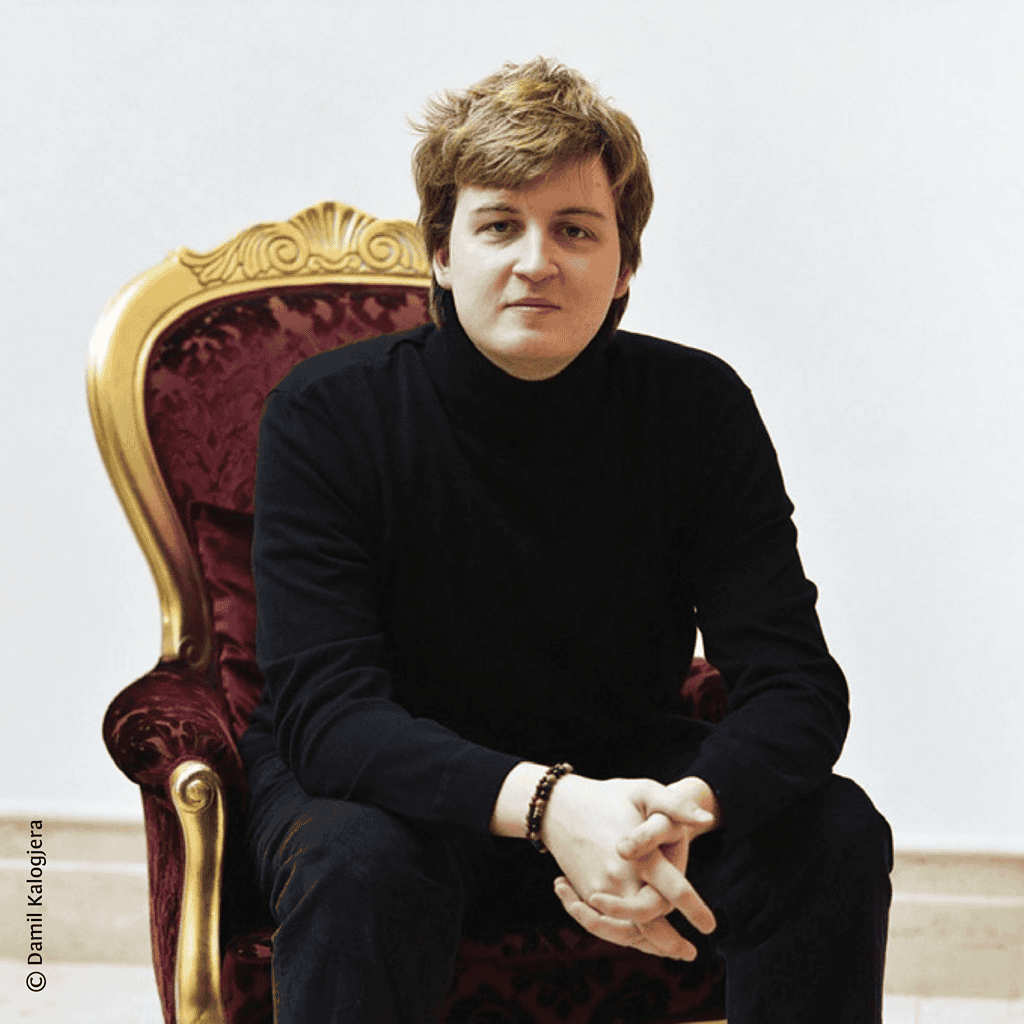
Ivan Vihor
Baroque music produced many outstanding composers who wrote for the harpsichord, yet among its greatest masters stand Johann Sebastian Bach, François Couperin and Jean-Philippe Rameau — figures who represent distinct cultures and styles, to the extent that one may speak of two Baroques: the German and the French.
The works of Couperin, Bach, and Rameau offer compelling examples of how musical language is shaped by cultural traditions, while also demonstrating how styles are enriched and transformed through mutual influence. Rather than viewing the Baroque through a strict dichotomy, it is more fruitful to understand it as a polyphonic space in which different artistic visions meet, complement one another and are transfigured.





About the program
In French harpsichord music, ornamentation and subtle rhythmic variation serve as primary means of expressing emotional tension and depth, giving rise to elegant, intimate, and playful miniatures rich in nuance and character. German harpsichord music, by contrast, is carefully constructed and profoundly logical, emphasizing structure, harmonic complexity, and textural layering, alongside a spirituality that at times approaches monumentality.
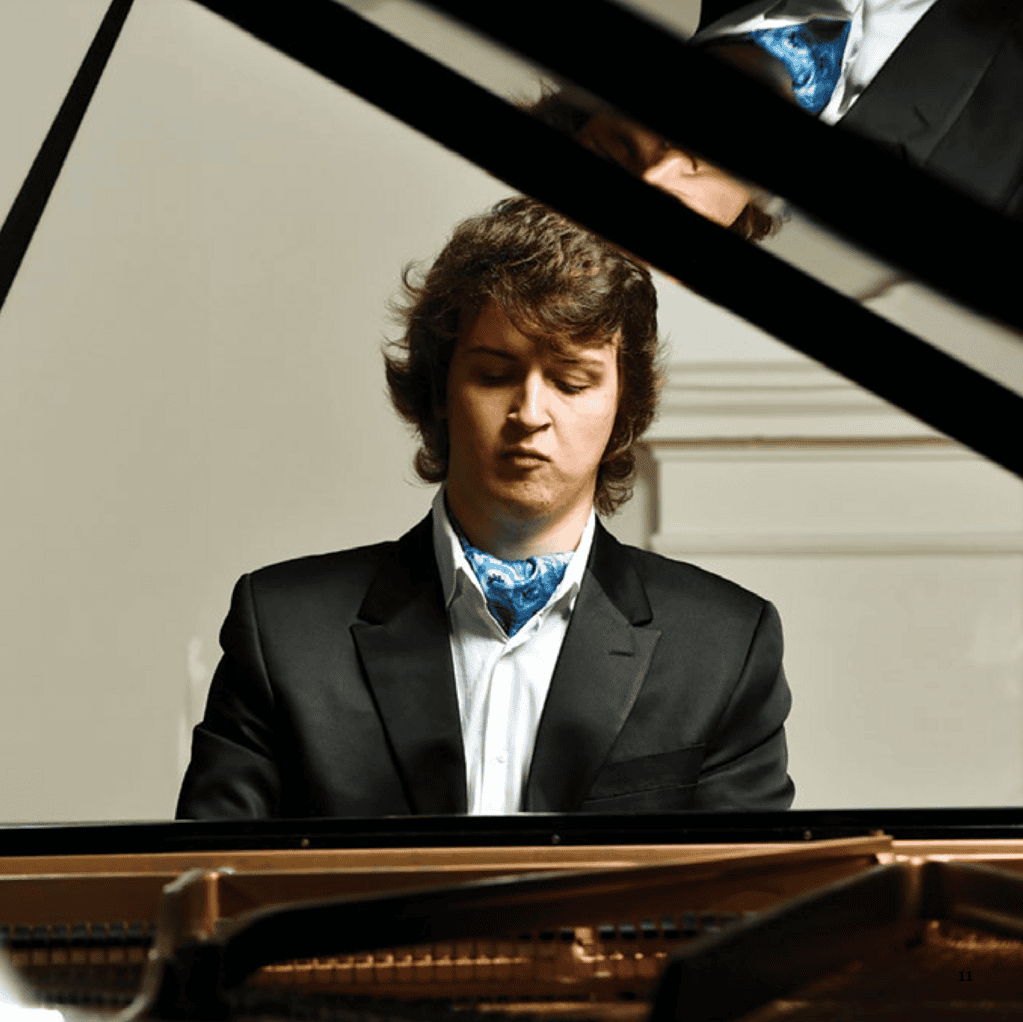
It is precisely these qualities that have inspired Vihor’s pianistic imagination and stylistic sensitivity. With a refined and delicate touch, he creates a crystalline sound world that vividly evokes the energy of a bygone age. His interpretations integrate a highly personal sonic vision with the full expressive range of the modern piano, bringing to life the shimmering harmonies, pulsating rhythms, and singing lines of music that was once more than an art form: it was a way of understanding the world, of seeking harmony within a life marked by discord — a truth that resonates just as strongly today as it did in the Baroque era.
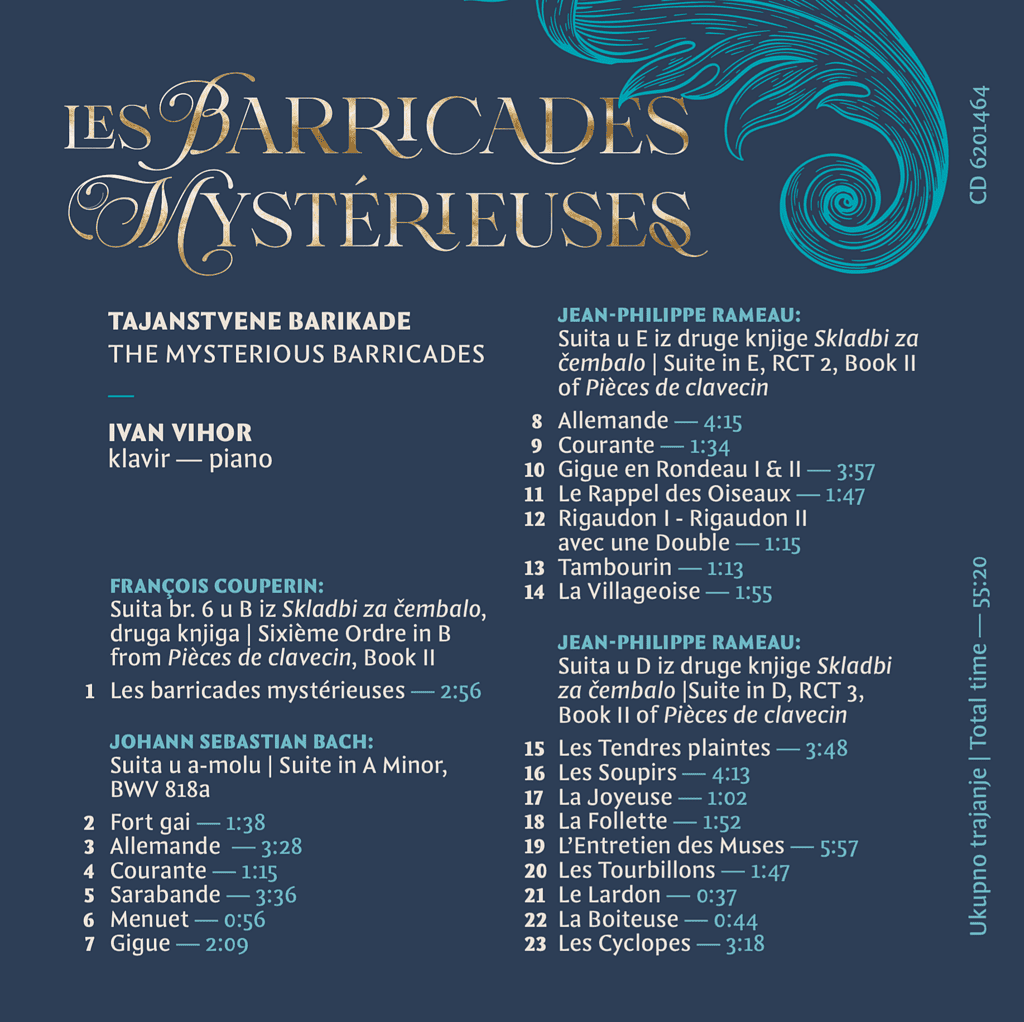
Couperin’s harpsichord masterpiece Les Barricades mystérieuses (The Mysterious Barricades) contains elements that continue to fascinate composers to this day. Written in rondo form, its brilliant yet simple theme generates an uninterrupted melodic flow spanning all four voices, while the recurring interplay of arpeggios and suspended dissonances creates an entrancing web of melody, rhythm, and harmony, enriched by a striking palette of tonal colour.
The piece forms part of the Sixth Ordre from François Couperin’s (1668 – 1733) Pièces de clavecin (published 1716/1717). These collections comprise twenty-seven ordres (suites) conceived as part of his pedagogical treatise L’Art de toucher le clavecin. Like Bach’s well-known Suites and Partitas, Couperin’s works also served a pedagogical purpose. They include numerous dance movements, but unlike Bach’s, they generally bear descriptive, evocative titles rather than generic dance names.
Known as le Grand, Couperin brought the French harpsichord tradition to its pinnacle. His influence extends far beyond his own time, shaping the music of composers such as Rameau, Chopin, Debussy and Ravel, and even reaching into the work of contemporary figures like Steve Reich, Philip Glass, and John Adams.
Couperin also left a mark on his contemporaries, including Johann Sebastian Bach (1685 – 1750). In Bach’s Suite in A Minor, BWV 818a, the Allemande — following the unusual Fort gai — opens with an allusion that recalls Couperin’s style. This is followed by a concise Courante of only sixteen bars, notable for its imitative counterpoint in a distinctly French manner. The Sarabande unfolds through graceful arpeggiations within a serene atmosphere, further enriched by the continuo line, which weaves an intricate musical tapestry. The suite concludes with the customary virtuosic Gigue. Across its six stylistically disciplined dance movements, marked by Bach’s characteristic motoric drive and rich ornamentation, the suite stands close to his French and English Suites — indeed, stylistically it occupies a position between them — yet it has remained somewhat overshadowed by those more famous works and is performed less frequently.
As the supreme representative of the German tradition, Bach cultivated a contrapuntal and motoric style. His suites and partitas strive to unite formal rigor, technical brilliance, and dense polyphony. At the same time, the Allemande from this suite reveals his assimilation of French elements, transformed through imitative counterpoint and elaborate ornamentation. Here, Bach’s ability to synthesize diverse stylistic traditions into a distinctive “German” idiom is particularly evident.
The harpsichord works from Jean-Philippe Rameau’s (1683–1764) Second Book although dating from roughly the same period as Bach’s, are markedly more robust and extroverted, partly due to their stronger reliance on basso continuo, which underpins their architectural clarity. They are quintessentially French in their richly ornamented style and dance rhythms, yet they also reflect Rameau’s intense preoccupation with harmony, expression, and virtuosity. It appears that Rameau never met his great contemporaries — not even François Couperin, fifteen years his senior and already firmly established at the French court by the time Rameau arrived in Paris. After his 1706 publication, he did not return to solo harpsichord music until the Pièces de clavecin of 1724, which reveal a mature composer who had fully developed his own style. In these works, Rameau transforms the instrument, boldly combining French elegance, Italian virtuosity, and his own obsessive fascination with harmony.
Rameau conceived his harpsichord music as a bridge between order and chaos, between the mathematical and the magical. Yet he never sacrificed clarity for brilliance. Every phrase is meticulously shaped, every chord precisely placed, revealing a composer who dared to dream on a grand scale while maintaining a perfect balance between intellect and passion — even within the smallest forms.
The Suite in E opens with a stately Allemande that initially suggests an older style, before Rameau introduces a second theme characterized by widely spaced intervals. This unexpected contrast, following the smooth motion of the opening, creates a striking effect of eccentric brilliance. Midway through, the melodic line suddenly shifts into the upper register, lending the music a new, almost vocal quality. The ensuing Courante adopts a more restrained tone, enlivened by occasional flashes of wit. Omitting the customary Sarabande, Rameau proceeds directly to a pair of Gigues: the first in the minor mode, tinged with melancholy, and the second in the major, radiant and triumphant. Both are cast in rondeau form, and in the latter Rameau introduces contrasting textures through alternating two-part writing — music that transforms the two-manual harpsichord into an astonishing palette of unique tonal colours. Most of the subsequent movements bear programmatic titles, though their precise meanings often remain elusive. The evocation of birdsong in Le Rappel des Oiseaux is unmistakable, followed by a triptych of energetic Rigaudons. The somewhat reflective Tambourin suggests a rustic dance, complete with lively drum-like effects. Whether the concluding rondeau, La villageoise, refers to a village girl, a country dweller, or something more abstract remains open to interpretation.
The Suite in D from the same collection presents a kaleidoscope of miniatures. Each piece evokes a distinct mood, character, or scene, all conveyed through titles that were particularly dear to Rameau. Thus La boiteuse stands out through its limping rhythm, while Les tourbillons suggests swirling clouds of dust on a windy day. La joyeuse and La follette are readily understood as images of joy and caprice, whereas in Les cyclopes, rapid scales and arpeggios conjure the mythical one-eyed giants. Other titles — Les tendres plaintes, L’Entretien des Muses, Les soupirs — remain more abstract, inviting the listener’s imagination.
About the performer
Ivan Vihor
Pianist Ivan Vihor made his orchestral debut at the age of ten, performing Bach’s Concerto in F Minor, BWV 1056, with the Festival Symphony Orchestra in Chioggia under the baton of Pietro Perini. Praised as a child prodigy of remarkable virtuosity, he soon began appearing in solo concerts and recitals.
He attracted wider public attention in 2017, at the age of twenty, when in Pesaro he won Italy’s most prestigious competition, the Premio delle Arti — becoming the only non-Italian in the history of the competition to do so. In the same year he was named Best Young Musician, winning both the national Papandopulo Competition and the International Ferdo Livadić Competition, where he also received the Croatian Composers’ Society Prize for the best performance of a work by a Croatian composer.
Thanks to these successes, he was invited to appear at a number of festivals: Osor Musical Evenings, Festival Samobor, St Mark’s Festival, the Spoleto Festival, Onde musicali Iseo, the Brescia and Bergamo Festival, Concerts du Cloître Nice, the Shandelee Music Festival New York, and the Monferrato Classic Festival, among others. Since then he has performed in Croatia, Slovenia, Austria, Italy, France, Germany, Liechtenstein, the Netherlands, Spain, the United States, Monaco, and South Korea under the direction of internationally renowned conductors (U. Lajovic, P. Perini, A. Ceccato, B. Šipuš, M. Tarbuk, I. Hut, and others).
Ivan Vihor is the recipient of more than fifty prizes at national and international competitions. In 2018 he was laureate of the Svetislav Stančić International Piano Competition in Zagreb, as well as the Massarosa Piano Competition and the Lazar Berman Piano Competition in Aversa, Italy. In 2019 he won the prestigious Talent of the Year award conferred by UBI Banca and the Brescia and Bergamo Festival, and in 2020 the Maestro Ivo Dražinić Award for the best young musician, presented by the Dubrovnik Symphony Orchestra and LAUS Academy.
He was among the finalists of the 12th Franz Liszt Piano Competition in Utrecht in 2020. In 2023 he reached the semi-finals of the Monte Carlo Music Masters as one of the four best pianists in the world and performed in the Salle Garnier of the Monte Carlo Opera at a special concert marking the centenary of the birth of Prince Rainier III. In December of the same year, he gave a recital in Seoul at the concert hall of Hankuk University.
He has recorded albums for MC Harmony (Schumann, Beethoven, Liszt) in 2015, and for Vox Primus the album Contradanza (Papandopulo, Bach, Liszt, Debussy) in 2020. His third album, Liszt – Transcriptions (Bach/Liszt, Liszt, Beethoven/Liszt), was also released by Vox Primus. That release earned a nomination for the International Classical Music Awards in the category Best Solo Instrumental Album, among 391 submitted releases from 117 record labels worldwide. On his fourth album, Les barricades mystérieuses, he interprets works by the Baroque masters Couperin, Bach, and Rameau.
Ivan Vihor was born in Rijeka in 1997. He began his musical education at the age of six in his native city, in the class of Professor Ana Dražul, with whom he also completed secondary school with the highest marks. At the age of sixteen he enrolled in piano studies at the Gaetano Donizetti Conservatory in Bergamo, Italy, in the class of Professor Marco Giovanetti, graduating cum laude. In 2023 he obtained a second master’s degree, likewise cum laude, at the Pinerolo Music Academy, and furthered his studies at the Accademia Incontri col Maestro in Imola in the class of E. Pace and R. Giordano, where in December 2022 he gave the doctoral performance recital, awarded the highest distinction. He has attended masterclasses with some of the world’s most distinguished pianists and pedagogues. He also studied harpsichord and basso continuo with S. Vartolo, D. Rocchi, M. Messori and M. Vincenzi at the Abaco Conservatory in Verona, and he also plays the viola.
Since spring 2019, Ivan has taught piano at the Gaetano Donizetti Conservatory in Bergamo, as well as at the Lettimi Conservatory in Rimini, the Buzzolla Conservatory in Adria, and the Ghedini Conservatory in Cuneo, Italy. Since December 2025, he has been on the faculty of the Academy of Music, University of Zagreb.
Ivan Vihor is also an active chess player; he has been multiple-time national champion and vice-champion, and holds the title of FIDE Master (FM).